
Introduction to
Artificial Intelligence
Scroll to Learn!
Map of AI
AI: Artificial intelligence (AI) is the ability of a digital computer or computer-controlled robot to perform tasks commonly associated with intelligent beings.
Machine Learning: a field of artificial intelligence that enables systems to learn from data, identify patterns, and make decisions or predictions without being explicitly programmed to.
Neural Networks: Neural networks are ML models inspired by the structure and function of the human brain. They consist of interconnected "neurons" organized in layers, that feed data forward, mathematically transforming inputs into an output.
Deep Learning/Deep Neural Networks -
The "deep" in deep neural networks refers to the fact thatthese networks have many (often dozens, hundreds, oreven thousands) hidden layers between the input andoutput layers allowing them to learn incredibly sophisticated patterns. These allow the creation of generative AI (GANs) as well as Large Language Models (LLMs) like Chatgpt

Applications of AI
AI has, and is set to continue changing our world. Due to its ability to learn and detect patterns beyond the capabilities of humans, AI has a diverse range of applications here are just a few examples:
-
Healthcare: Analyzing medical images for disease detection (e.g., cancer, diabetic retinopathy).
-
Autonomous Vehicles: Enabling self-driving cars to perceive surroundings and navigate.
-
Speech Technology: Facilitating accurate speech recognition and realistic speech generation.
-
Fraud Detection: Identifying suspicious patterns in financial transactions and cybersecurity.
-
Recommendation Systems: Personalizing content suggestions on platforms like Netflix and Amazon.
-
Content Generation: Creating new content like realistic images, music, and human-like text.
-
Robotics: Allowing robots to learn, manipulate objects, and navigate environments.
-
Investment Planning: Forecasting trends for various markets.
-
Customer Service Chatbots and Smart Assistants: Can understand and generate human language to aid customers

This is a brain tissue MRI scan. Researchers at the University of Cambridge developed an AI tool that can predict Alzheimer's progression in individuals with early dementia signs with 82% accuracy using simple cognitive tests and MRI scans (eClinical Medicine, 2024)
History and Evolution
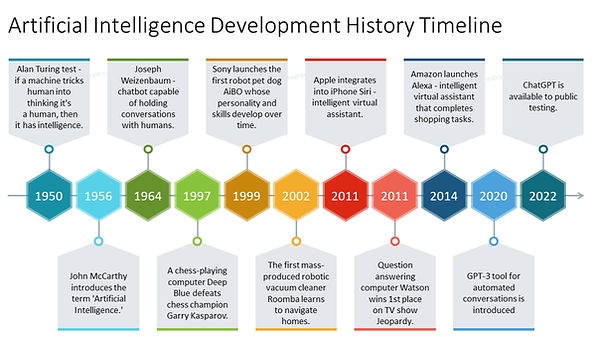
AI has taken years to develop into what it is today. Since Alan Turing first asked the question 'can machines think?' it has been more than 70 years. During that time AI has reached the level that its conversations are often indistinguishable from those of humans in many ways. However, AI still has many limitations. While AI can learn and imitate human speech, it lacks true understanding. It simply follows patterns it sees like a very sophisticated copycat, arranging words based on the patterns learned from text on the internet.
Future of AI
At the 2025 Consumer Electronics Show, Nvidia CEO Jensen Huang discussed the continued evolution and future of AI in 4 stages.
1. Perception AI: Ability to interpret and understand environment through various sensory inputs such as audio from a microphone or video from a camera.
2. Generative AI: Ability to generate new content from learned patterns in the environment. Includes speech generation like that of voice assistants, text generation from LLMs like ChatGPT, and creation of deepfake video and audio.
3. Agentic AI: The creation of autonomous AI agents that have a specific goal. While other types of AI are learn and evaluate themselves on their ability to make predictions or find patterns, Agents have real-world metrics such as performance of an investment portfolio or number of likes on their social media posts that they autonomously learn to improve.
4. Physical AI: The integration of Agentic AI and mechanical hardware which allows AI to work in our physical world. This includes agents that power humanoid robot assistants or self-driving cares

Another way that Computer scientists and engineers envision the future of AI is through the distinctions between narrow/weak, general, and super AI. This perspective proposes a world in which AI becomes smarter than humanity in all realms
